


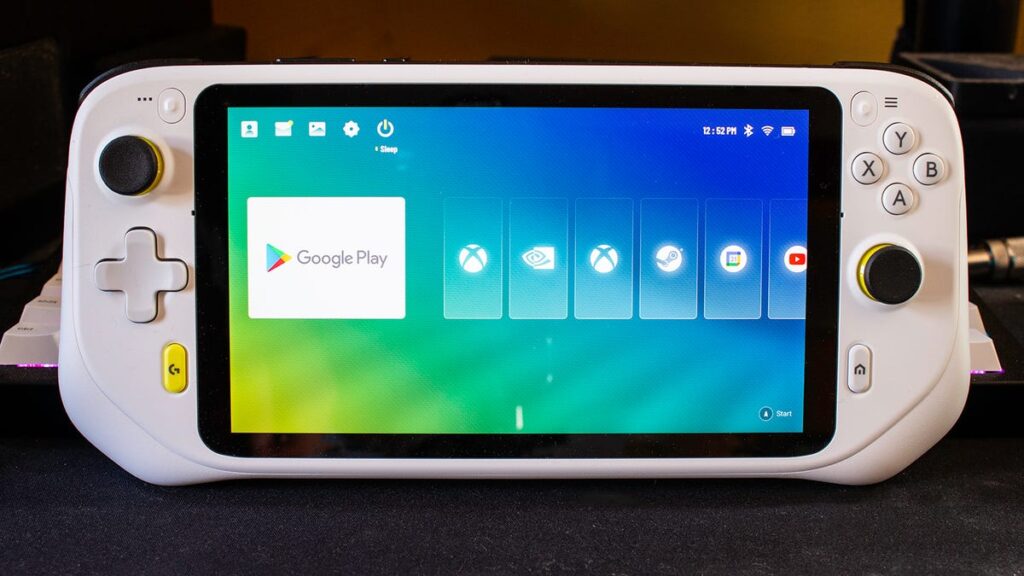
The Logitech G Cloud aims to carve out its space in the crowded portable gaming market by combining hardware quality with cloud-based gaming capabilities. While it boasts impressive design and build quality, the experience is hampered by software inconsistencies, cumbersome interfaces, and the inherent challenges of cloud gaming. This device promises the convenience of playing AAA titles virtually anywhere, but in practice, it often falls short of that ideal, leaving users frustrated and longing for a more seamless experience.
Logitech G Cloud
Rated 3 out of 5 stars
Pros
- Buttons and analog sticks feel smooth and responsive
- Display offers sharp visuals, especially at higher brightness levels
- When functioning properly, provides genuinely engaging gaming sessions
Cons
- Interactions with various platforms and games can be buggy and unreliable
- Touchscreen elements often respond poorly or inconsistently
- User interface exhibits confusing and inconsistent design choices, complicating simple tasks
Pricing options include $320 at Amazon, or $350 at Best Buy and Logitech’s official store.
Portable gaming devices have a rich history, beginning with Nintendo’s Gameboy, which revolutionized handheld gaming by providing a compelling experience on the go. Numerous companies have attempted to emulate that success, with varying degrees of effectiveness. Today, the market is experiencing rapid diversification, with Nintendo’s Switch still reigning supreme, but facing stiff competition from devices like Valve’s Steam Deck, Razer’s upcoming Edge gaming handheld with 5G connectivity, and the Logitech G Cloud.
Logitech’s approach is to offer an Android-based handheld that leverages streaming services like Nvidia GeForce Now and Xbox Cloud Gaming. The goal is to enable players to access high-end PC titles alongside mobile games from the Google Play Store. On paper, this sounds like a game-changer.
However, in practice, a series of minor yet persistent issues—such as interface bugs, platform inconsistencies, and Android’s limitations—make the gaming experience inconsistent and often frustrating. These problems can diminish the device’s potential, turning what should be an effortless gaming solution into a source of annoyance.
Also: the best gaming consoles
Specifications
- Processor: Qualcomm Snapdragon 720G
- Display: 7-inch 1920 x 1080 IPS LCD touchscreen with 60Hz refresh rate
- Memory: 4GB RAM
- Storage: 64GB built-in, expandable via microSD card
- Controls: A/B/X/Y buttons, D-pad, L&R analog sticks, bumpers, triggers, G button, Home button, volume controls, power switch
- Battery: 23.1 Wh Li-Po battery, estimated to last over 12 hours
- Connectivity: Dual-band Wi-Fi, Bluetooth 5.1
- Operating System: Android 11
- Color Options: White
Hardware
The G Cloud’s aesthetic is enhanced by subtle accent colors that prevent it from looking sterile. Logitech, known for high-quality peripherals, has delivered hardware that feels premium. The analog sticks glide smoothly without drift during testing, and all buttons are crisp and responsive. The 7-inch touchscreen responds accurately to touch, making navigation and interaction straightforward when the interface is well-optimized for touch controls.
On the top edge, you’ll find bumper and trigger buttons, along with a volume rocker and a power/sleep slider. One notable disappointment is the triggers, which are too shallow to comfortably grasp like traditional controllers or even the Switch Joy-Cons. Increasing their height could have improved ergonomics without adding much thickness. Still, the triggers’ springiness provides good feedback during gameplay, aiding in acceleration or braking in racing titles.
The bottom edge includes the 3.5mm headphone jack and the USB-C port for charging or connecting peripherals. The device’s stereo speakers, though small, produce surprisingly loud and clear sound without distortion. Directional audio cues are easily recognizable, and Bluetooth headphones or headsets can be used effortlessly, provided users are mindful of potential Bluetooth latency issues during fast-paced gaming.
The microSD card slot, located in the top corner, expands storage beyond the default 64GB, accommodating larger game libraries and media files. The 7-inch display offers vibrant visuals, although its size can make distant enemies harder to spot—an inevitable compromise between portability and visibility that all handhelds face.
Overall, the G Cloud’s hardware is solid and well-built, capable of handling demanding gaming scenarios—assuming the software plays ball. But, as with many cloud-focused devices, the experience hinges heavily on stable internet connections and reliable platform support.
Gaming Performance
The device’s interface starts up quickly, offering a clean and organized layout that makes navigating apps and services straightforward—at least in theory. In practice, many pre-installed apps and streaming services are plagued by bugs or confusing UI elements, detracting from overall usability.
When the G Cloud functions correctly, it’s a joy to use. I tested it with GeForce Now, and once the connection was established, I was immersed in Genshin Impact for hours, marveling at how responsive and crisp the gameplay was on the small screen. The controls felt natural, and cloud streaming delivered a surprisingly smooth experience.
However, these moments were rare. More often, I encountered frustrations like long wait times, login errors, or platform incompatibilities. For example, attempting to play Apex Legends via GeForce Now was a convoluted process involving multiple logins and two-factor authentication, often ending in error messages that prevented gameplay altogether. The process of signing into various platforms—Steam, EA, Google, and Nvidia—was cumbersome, especially when inputting credentials via the device’s small touchscreen.
Similarly, Genshin Impact initially refused to recognize the built-in controller, forcing me to rely on touchscreen controls for the first 15 minutes of gameplay. Even after switching to the Android version, I faced inconsistent hardware recognition, which intermittently rendered the controls useless. Such issues underscore the device’s software shortcomings, which undermine the hardware’s potential.
While Microsoft’s Xbox Cloud Gaming was somewhat more stable, it still suffered from stuttering and loading issues common across cloud services, as I experienced in my review of the Acer Chromebook 516 GE. The dream of instant, seamless cloud gaming remains elusive, especially when relying on third-party platforms that have their own stability problems. Logitech’s role is to deliver a smooth end-user experience, but frequent hiccups diminish the device’s promise.
For more insights on streaming features, you might explore how to enhance your streaming achievements, such as earning the game dev badge on Twitch, which can add a fun layer to your gaming profile.
Bottom Line
The G Cloud’s back panel features one of the best grip coatings I’ve encountered on a portable device, providing comfort during extended play sessions. However, it also shows faint marks easily, which could be a concern for those who want a pristine look over time.
Android’s fragmented ecosystem remains a significant obstacle. The decision to base the device on Android was a gamble, given its ongoing struggles to unify hardware and software standards across countless manufacturers. Cloud gaming amplifies these issues, requiring multiple accounts, apps, and login procedures that can be overwhelming—especially on a small touchscreen.
Throughout testing, I often found myself wishing for the simplicity of a dedicated console or a traditional gaming PC. The promise of cloud gaming is that it can make high-quality gaming portable and accessible, but frequent delays, login hassles, and UI quirks often make that promise hard to fulfill. When everything finally works, the device can deliver a satisfying gaming experience, but those moments are too few and far between. Logitech should collaborate more closely with cloud service providers like Nvidia and Microsoft to streamline the experience, fix bugs, and improve usability.
Early impressions suggest that with its excellent hardware, the G Cloud has the potential to become a solid portable gaming device—if software issues are addressed. Until then, expect some patience and perseverance when launching titles, and weigh whether the device’s portability and capabilities outweigh the frustrations of its current software state.
Also: exploring the best gaming GPUs
Alternatives to Consider
- Nintendo Switch Lite: Typically priced at $229.99 at Best Buy, it doesn’t support AAA PC titles but offers reliable performance and can double as a home console for TV gaming.
- Valve Steam Deck: Available for $399 at Steam, it runs a custom Linux OS that supports both cloud services and locally installed games, providing excellent flexibility and reliability.
- Razer Edge: Priced at $400 at Razer’s store, this upcoming device boasts 5G connectivity, potentially enabling gaming from virtually anywhere with compatible networks. You can reserve one for just $5 as a pre-order, making it an intriguing option for future portable gaming.
Until hardware and software evolve further, balancing portability with seamless performance remains challenging. For dedicated gaming performance, exploring options like the Steam Deck or Switch may offer a more reliable experience.
Additional resources include guides on improving your cloud gaming setup, such as how to enhance streaming achievements, which can help optimize your overall gaming profile and experience.